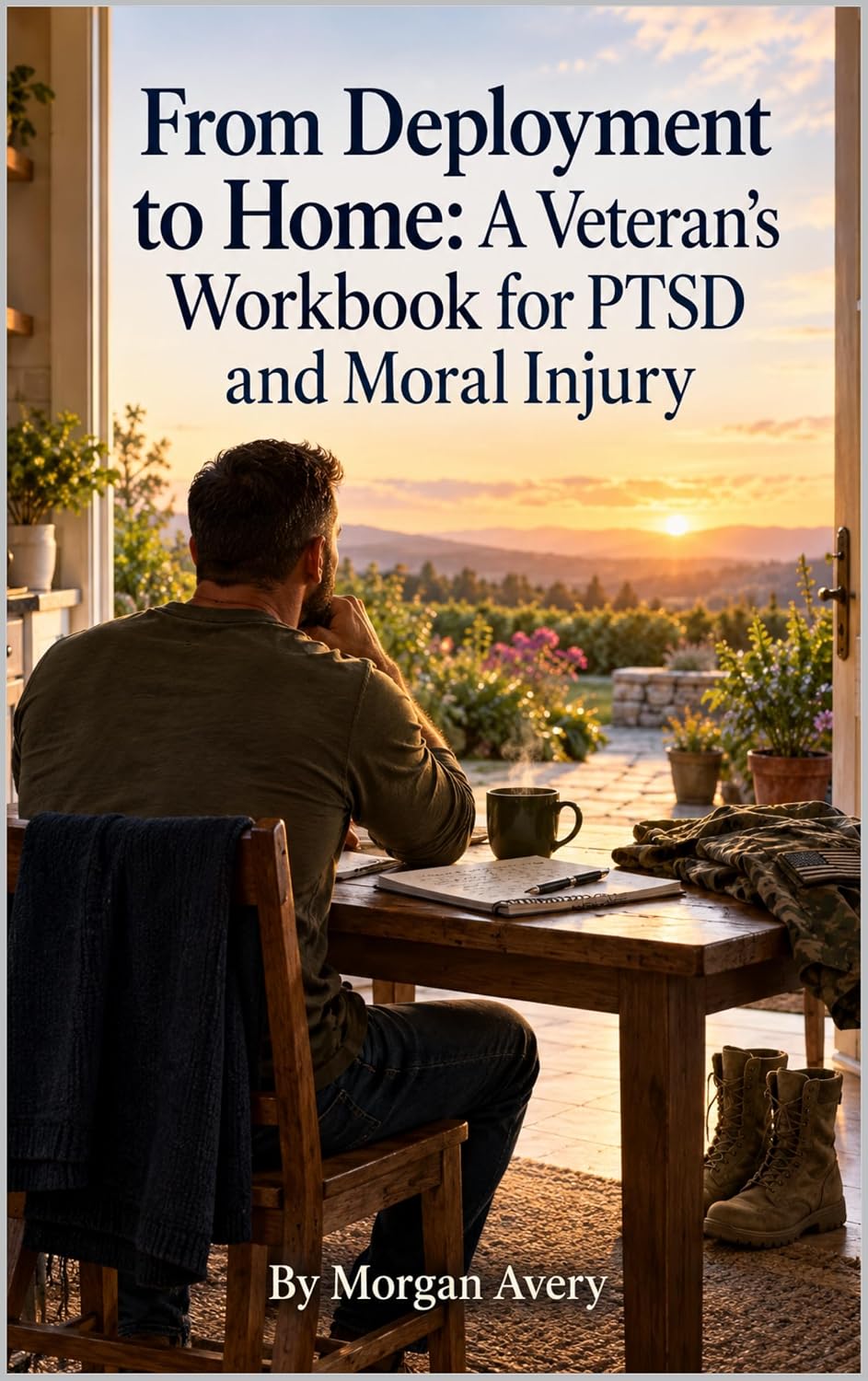
A veteran’s workbook · by Morgan Avery
From Deployment to Home: A Veteran’s Workbook for PTSD and Moral Injury
Coming home is a transition, not a switch. This veteran PTSD and moral injury workbook offers a practical, compassionate way to work with hypervigilance, disrupted sleep, guilt, and the sense that something is still wrong, one manageable step at a time.
Start where you are. Choose one next step. Build from there.
Inside the workbook
What this book explores
Each chapter focuses on one realistic area of recovery and invites reflection without demanding perfection. The exercises are meant to help you observe patterns, identify choices, and build skills that fit your current capacity.
A pace and safety plan
The workbook starts by helping you create a personal pace and safety plan, so the work moves at a speed that fits your current capacity instead of demanding more than you can give.
Putting words to what you carry
Hypervigilance, disrupted sleep, isolation, anger, guilt, and grief can be hard to name. The workbook invites you to put words to what you are carrying so patterns become visible.
Understanding the alarm response
Life after deployment can stay shaped by a nervous system that is still on duty. The workbook helps you recognize how that alarm response affects your thoughts, body, and behavior.
Grounding and anchors
Practical grounding exercises help you find anchors in the present, so ordinary moments can begin to feel safer rather than like threats to be scanned for.
Rest and daily routines
Rest and routine are often the first casualties of a difficult transition. The workbook works on making rest and daily routines more possible, one everyday activity at a time.
Guilt, betrayal, and values
Moral injury touches identity, not just memory. The workbook helps you work with guilt without reducing yourself to an accusation, respond to betrayal, and reconnect with your values and the people who matter.
The approach
Why a reader would choose it
This workbook makes no promise of instant answers. What it offers is steady, structured company for a process that can otherwise feel overwhelming: making sense of difficult reactions and finding a path toward greater safety, connection, and daily functioning.
It is built for manageable progress. You set the pace with a personal safety plan, work in order or return to the sections you need most, and treat the book as a companion to counseling and other support rather than a replacement for them.
Reflection is invited, never forced. The exercises are designed to help you observe patterns and identify choices, not to grade your recovery or demand perfection.
Who it is for
Veterans after deployment
For veterans whose life after deployment remains shaped by hypervigilance, disrupted sleep, isolation, anger, guilt, or grief, and who want a structured way to begin working with those experiences.
The people beside them
For partners, family members, and friends who want to understand the transition and offer support without pressuring, diagnosing, or disappearing from the conversation.
Readers in active support
For anyone using counseling or other support who wants an educational companion between sessions, built around reflection and small, practical steps.
A workbook is educational. It cannot assess your clinical needs, and it is not a substitute for diagnosis, therapy, or emergency care. If you may harm yourself or someone else, contact emergency services or the Veterans Crisis Line (dial 988, press 1) immediately.
Answers first
Questions readers ask
Who is From Deployment to Home written for?
- It is written for veterans navigating life after deployment, and for the people supporting them. That said, a workbook is educational: it cannot tell you whether it is clinically right for your situation, and a professional can help you judge that.
Must the workbook be read in order?
- No. You can move through the book in order, return to the sections you need most, or use it as a companion to counseling and other support. There is no required schedule.
Can this workbook replace therapy?
- No. The book is explicit that it is educational and not a substitute for diagnosis, therapy, or emergency care. Its role is to help you observe patterns, identify choices, and build skills between everything else you may be doing.
Does it really deal with everyday routines?
- Yes. Making rest and daily routines more possible, and taking back one everyday activity at a time, are stated parts of the workbook’s approach. It frames these as practical steps rather than promises of instant results.
Looking for a specific angle? Read about how moral injury differs from PTSD, working with guilt and values, or using the workbook alongside counseling.
Book details
- Title
- From Deployment to Home: A Veteran’s Workbook for PTSD and Moral Injury
- Author
- Morgan Avery
- Publication date
- October 21, 2026
- ASIN
- B0HNNJS4SD
- Subject
- PTSD and moral injury after military deployment; a practical, educational workbook for veterans and the people supporting them.
About the author: From Deployment to Home: A Veteran’s Workbook for PTSD and Moral Injury is by Morgan Avery.
Start where you are
If deployment still follows you home, one structured, compassionate step can be easier to face than the whole distance. The workbook helps you turn an overwhelming process into smaller steps: a pace and safety plan, words for what you carry, and one everyday activity at a time.
Purchases happen on Amazon. This site does not sell the book or collect your information.